TITAN Robot: Underactuated Pick-and-Place
Design and prototyping of an innovative 4-degree-of-freedom parallel robot. The core innovation? Grasping requires no embedded motors: the geometric deformation of the structure itself actuates a compliant Fin-Ray gripper.
1. Modeling & Singularity Avoidance
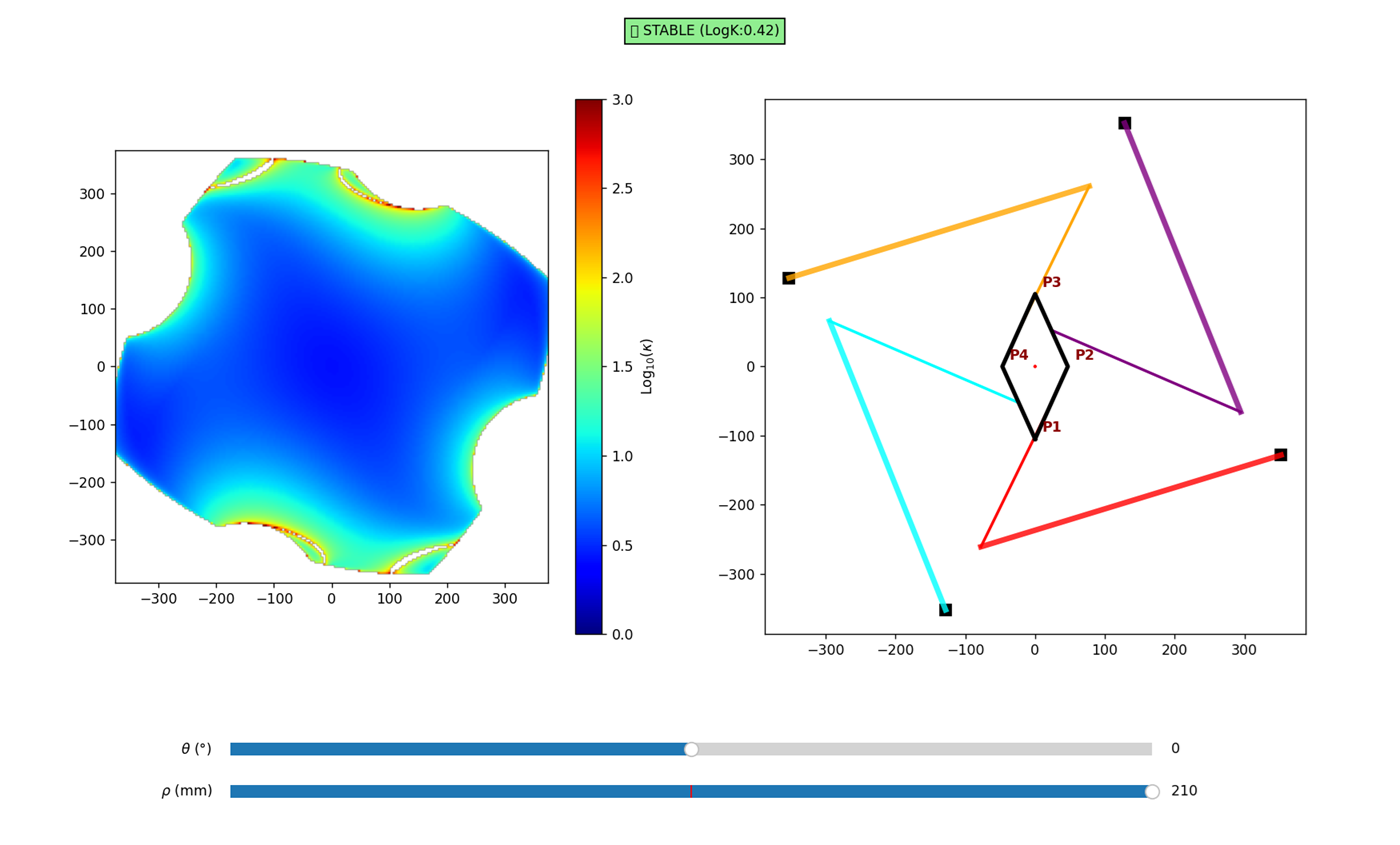
In parallel robotics, the workspace is often constrained by kinematic singularities (loss of control or infinite joint forces).
To secure the robot, I developed a Python algorithm that maps the 4D operational space. It computes the Inverse Kinematics (IK) and the Jacobian matrix to generate Heatmaps evaluating the robot's condition number.
These dexterity maps dictated the final dimensional synthesis, ensuring a fully stable 200x200mm useful workspace.
2. Compliant Mechanism & Fin-Ray Effect
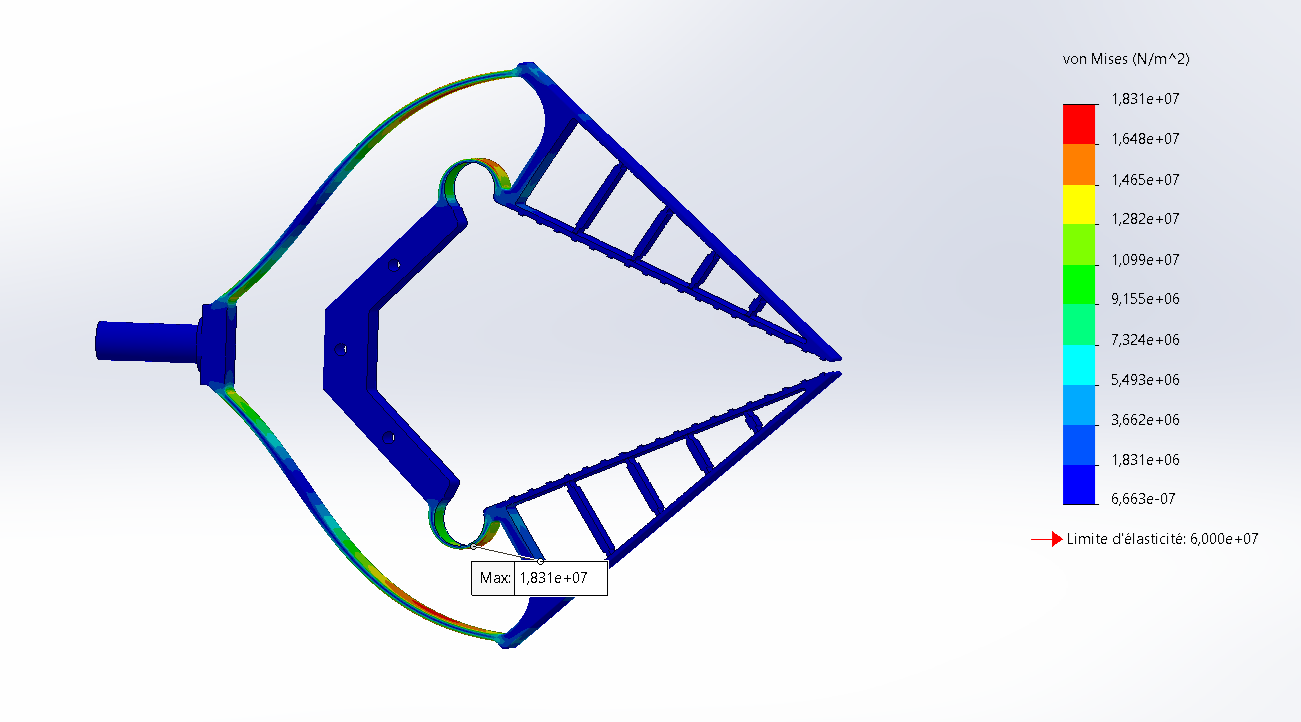
The central end-effector is an underactuated mechanism: the contraction of the robot's diagonal pushes a central rod that triggers a sequential "double-action" mechanism.
At the end of the stroke, a toggle mechanism amplifies the force transmitted to the gripper jaws. The jaws utilize the Fin-Ray effect: 3D printed in SLS Nylon, they bend inward to perfectly wrap around the grasped object.
These elastic deformations were validated through Finite Element Method (FEM) simulations in SolidWorks.
3. Digital Twin & Motor Sizing
To size the Parker servomotors, the CAD assembly was exported to Simscape Multibody. As shown here, this digital twin allowed for the validation of the architecture's dynamic behavior.
Simulations evaluated the required torques during high-acceleration phases and gripper closure (injecting a 9N reaction force). This dynamic analysis dictated the choice of Carson low-backlash planetary gearboxes to overcome the critical 5.5 Nm peak identified during clamping.
4. Real-Time Control & Proof of Concept
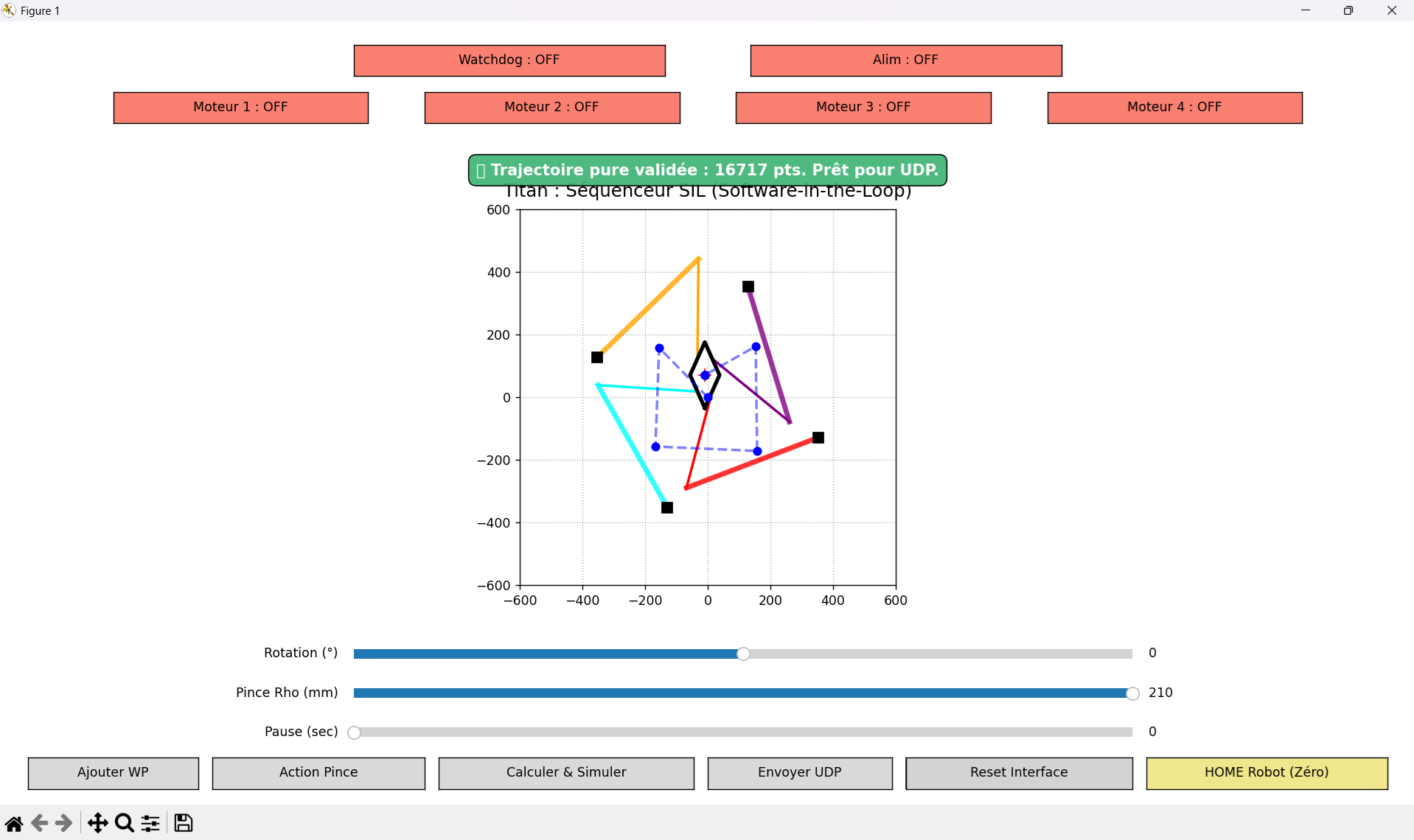
A Software-in-the-Loop (SIL) sequencer was coded in Python. The GUI allows users to place Waypoints, avoid singularities, and smooth trajectories using Gaussian filtering.
The setpoints are sent via UDP to a MATLAB/Simulink controller managing the PID loops. Communication with the motor drives is handled via the EtherCAT real-time protocol.
The real-world challenge: To compensate for the inertia of the aluminum arms and the mechanical backlash of legacy gearboxes, resonance frequency filtering and Feedforward control were implemented, stabilizing the robot and validating the physical Proof of Concept.
Want to see more?
The Python sequencer source code and details of the Simulink architecture are available (partially or upon request) on my GitHub.
View code on GitHub